
Less Gamble. More Governance. Contract Engineering Support.

Contract Engineering Experts
Why Business Leaders Are Choosing Contract Engineering Support Instead of Hiring Another Full Time Employee (FTE)
· Faster capacity, lower hiring drag, and a lower-risk way to get critical work done.
· Freelance engineering support can be a gamble.
With Broadview Product Development, you get fractional engineering support from W-2 employees—not a loose network of 1099s. That means less administrative hassle, reduced classification risk, and a company that stands behind the work.
o W-2 engineering team
o Professional services model + governance
o Scale bandwidth without hiring
Executive Summary
For many manufacturers and product teams, the question is no longer whether engineering support is needed — it’s how to add productive engineering capacity quickly, with minimal risk and disruption. Hiring a full-time engineer can be the right move for long-term, steady-state demand. But for many real-world situations—launch pressure, backlog spikes, specialized projects, documentation pushes, fixture/jig work, prototyping, design updates, manufacturing support, supplier transitions, and validation work—contract engineering support can deliver value faster and with less organizational drag.
This is especially relevant in a hiring environment where employers continue to report difficulty finding skilled talent. SHRM notes many organizations struggle to fill full-time roles, and talent/skills gaps can extend onboarding timelines and delay strategic initiatives. (Society for Human Resource Management, SHRM)
The strategic case for contract engineering support is simple:
· You avoid the full hiring cycle delay (requisition, recruiting, interviews, offer, notice period).
· You reduce ramp-up burden versus a brand-new employee who still needs months of onboarding and integration.
· You scale capacity without permanent headcount commitment.
· You lower risk compared with managing ad hoc freelancers/1099s directly.
· You keep momentum on revenue-critical engineering and operations work.
For companies that need speed and accountability, Broadview’s model is designed to be the practical middle ground: flexible capacity with professional oversight.

The Hidden Cost of “Just Hire an FTE”
On paper, hiring a full-time engineer sounds straightforward. In practice, it is a multi-stage process that consumes time from HR, hiring managers, engineering leaders, and peers.
1)Time-to-fill creates a real business delay
Workable’s recruiting metrics guide (citing SHRM) notes an average time-to-fill benchmark of 42 days, and cites an engineering average global time-to-fill of 62 days. (Recruiting Resources) Even if your process is better than average, critical engineering roles often require: technical screening multiple interview rounds cross-functional alignment compensation negotiation notice period waiting time That means your project doesn’t simply wait for a hire—it often loses momentum for weeks or months. The Hidden Cost of “Just Hire an FTE”
2) Hiring is more than salary

Even before the new engineer contributes, organizations absorb: recruiting effort and management time interview time from technical leads HR/admin processing onboarding setup (systems, equipment, training, compliance) opportunity cost from delayed project progress SHRM has long highlighted that hiring costs include substantial “soft costs” beyond direct recruiting spend. (SHRM) For business leaders, that means the true cost of hiring is often higher than the offer letter suggests.
3) Onboarding and ramp-up are often underestimated
SHRM emphasizes that onboarding should be treated as a strategic process and can last months (and in some organizations, up to a year), with time-to-productivity as a core metric. (SHRM) That matters because a newly hired FTE is not instantly “plug-and-play.” Even a strong engineer needs time to learn:
· your products and product history
· your processes and approval flow
· your documentation standards
· your Enterprise Resource Planning/Product Lifecycle Management/Quality Management Systems environment
· your suppliers and manufacturing realities
· your internal politics and communication norms
Contract support doesn’t eliminate ramp-up—but when structured well, it can compress it by aligning effort to defined deliverables and bringing in experienced contributors who are used to entering projects midstream.

When Contract Engineering is the Better Business Decision
Hiring an FTE is often best for permanent, predictable demand. But contract engineering is typically the stronger option when the need is urgent, specialized, variable, or project-based.
Best-fit scenarios for contract engineering support
· Backlog spikes (you need capacity now, not in 2–4 months)
· Product launch crunches (documentation, design for manufacturability updates, prototype iterations)
· Short-term but critical initiatives (fixture design, line support, validation, test support)
· Skill gaps (specialized CAD, prototyping, manufacturing engineering, supplier/ops support)
· Bridge coverage (parental leave, open req gap, transition period)
· Uncertain demand (you need bandwidth, but not permanent payroll commitment yet)
In these cases, the strategic advantage is not just labor flexibility—it is decision speed.

Why “Freelancers”
& “Contract Engineering”
Are Not the Same Thing
This is where many organizations encounter unexpected risk. A freelancer marketplace or independent 1099 arrangement can look fast at first. But it often shifts risk and coordination burden back onto your team:
· vetting and technical screening
· scope definition
· performance management
· continuity risk
· handoff/documentation gaps
· classification/compliance concerns
Classification & Compliance Risk is Real
Misclassification risk can carry more than administrative inconvenience. If an independent contractor relationship is later challenged, companies can face retroactive exposure tied to workers’ compensation, unemployment taxes, employer-paid Social Security and Medicare, payroll withholding issues, and certain benefits-plan or retirement-plan compliance questions. For leaders, that means the “lower-cost freelancer” option may introduce financial risk well after the work is complete.
Worker misclassification enforcement has increased in recent years, making classification decisions more visible and consequential for employers. The IRS makes clear that worker status depends on the substance of the relationship, not the label, and evaluates factors tied to behavioral control, financial control, and the relationship itself. (IRS)
The U.S. Department of Labor also maintains guidance and enforcement resources related to employee vs. independent contractor classification under the FLSA, and federal guidance has been revised and revisited in recent years.
For business leaders, the takeaway is not “never use contractors”. Rather, it’s: Use a model that reduces ambiguity and administrative burden.
Broadview Product Development’s contract engineering model is designed specifically to reduce this ambiguity while providing the accountability of a company-backed engineering team.

The Broadview Difference: Fractional Engineering Support Without the Freelance Gamble. Broadview Product Development offers a different model than “find a freelancer and hope.”
What business leaders get with Broadview Product Development:
1) W-2 engineering team (not a loose 1099 network). You get access to professionals backed by a company, with accountability and continuity. Broadview Product Development’s fractional engineering team members are W-2 employees of Broadview Product Development. Vacation days, sick time, and holidays are already accounted for within Broadview Product Development’s billable rate structure. Clients are not paying those days off as separate line items, which is one reason a direct comparison between a freelance hourly rate and Broadview Product Development’s professional-services model can become an apples-to-oranges exercise.
2) Professional services model + governance. Broadview can operate with clearer scope, communication cadence, and delivery expectations —helping reduce the “randomness” that often comes with ad hoc freelance support.
3) Scale bandwidth without adding headcount. You can add engineering support where it matters most—without carrying permanent payroll and benefits for variable demand. Whether you need five hours, 15 hours, or 40 hours, our team can step in—and step out—as your needs require.
4) Lower internal hiring/admin load. Instead of running a full recruiting process, your team can focus on project priorities and outcomes.
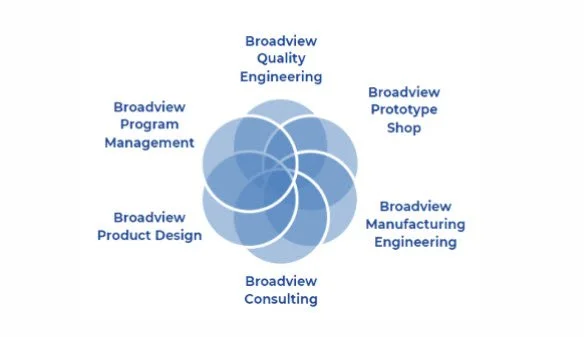
5) A company that stands behind the work . This is the biggest distinction from many freelance arrangements: you’re not only hiring a person, you’re engaging an organization.

Business Case Framing for Leaders
When evaluating FTE vs. contract engineering support, leaders should compare more than hourly rate or salary.
A Better Decision Framework
Ask:
· How fast do we need productive engineering capacity?
· Is this workload steady for 12+ months, or variable?
· How costly is delay to launch, quality, or output?
· Do we need a generalist employee or specialized support now?
· Can our internal team absorb the hiring and onboarding burden right now?
· Are we prepared to manage independent contractors directly?
If speed, flexibility, and reduced management overhead matter most, contract engineering support often wins—even if the hourly rate appears higher than salary math in isolation.
Why? Because the real comparison is: FTE cost vs. delivered outcomes during the time window that matters. In many cases, the cost of delayed progress exceeds the premium for flexible engineering capacity.
A Practical Hybrid Strategy (What Smart Teams Do)
This is not an “FTE vs. contract” ideology decision. The strongest organizations often use both.
Recommended approach: Use our contract engineering support to address immediate needs, bottlenecks, and specialized work Hire FTEs selectively for stable, long-term core roles Reassess after project milestones whether demand justifies permanent headcount
This approach helps leaders avoid two common mistakes:
1.Over-hiring too early for demand that may taper
2.Under-resourcing critical projects while waiting for an FTE search to finish
Conclusion
If your team is under pressure to deliver, waiting for the perfect full-time hire can be the most expensive option—especially when time-to-fill, onboarding, and ramp-up are considered.
Contract engineering support gives business leaders a way to:
move faster,
reduce internal hiring drag,
access specialized capability,
scale intelligently.
And when that support comes through Broadview Product Development’s W-2 engineering and consulting teams, you get a practical advantage over freelance-only models: less gamble, more governance, and a partner that stands behind the work.
Sources:
SHRM (Talent Trends / recruiting challenges and skills-gap impacts) (SHRM)
SHRM (Onboarding guidance and time-to-productivity metrics) (SHRM)
Workable recruiting metrics FAQ (cites SHRM benchmark for time-to-fill; includes engineering benchmark reference) (Recruiting Resources)
ManpowerGroup U.S. Talent Shortage 2025 (difficulty finding skilled talent) (manpowergroupusa.com)
NFIB small business sentiment/jobs data (qualified applicant scarcity and unfilled openings) (NFIB - NFIB Small Business Association)
IRS common-law employee guidance (classification factors) (IRS)
U.S. Department of Labor misclassification resources and enforcement guidance updates (DOL)
P: 616.772.4560